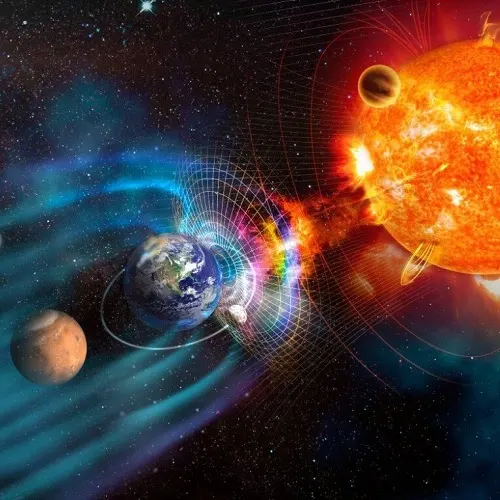
Planets rotate because of the conservation of angular momentum during the formation of the Solar System.
Why do planets rotate is a question that leads directly to the laws of motion that shape the universe. The rotation of planets dates back to the early formation of the Solar System billions of years ago. At that time, a vast cloud of gas and dust began to collapse under its own gravity. As it contracted, it started to spin faster, and this motion was preserved through the physical law known as the conservation of angular momentum. The planets formed from this spinning disk inherited that rotation. Just as the story of why Satan rebelled against God and refused to bow symbolizes that nothing escapes the laws of order, the planets, too, are bound to the cosmic laws that keep them turning endlessly through space.
The conservation of angular momentum
In physics, the conservation of angular momentum explains why a rotating system keeps spinning unless acted upon by an external force. A simple example is a figure skater spinning faster by pulling in their arms. The same principle applied to the early Solar System: as the gas cloud shrank, it spun more rapidly, transferring its momentum to the forming planets and the Sun. This rotation has never ceased. Every planet, from Earth to Jupiter, continues to spin around its axis. The rotation also influences essential planetary properties — it creates day and night cycles, shapes magnetic fields, and stabilizes climates through consistent energy distribution.
Cosmic balance and perpetual motion
The fact that planets rotate is a sign of the universe’s balance. Nothing in the cosmos is static; motion sustains stability. Rotation allows energy to remain conserved and systems to stay in equilibrium. If planets were to stop spinning, gravitational forces and thermal balances would collapse, leading to catastrophic instability. Rotation, therefore, is not just motion — it is existence itself. The reason planets rotate is both physical and philosophical: motion is the law of being. Every turning planet is a reflection of the universe’s eternal order, where movement ensures harmony, continuity, and the rhythm of life across the cosmos. /