Niye Neden
NiyeNeden.com
Why, Reason, Explained!
Health Life Technology Islam Machine Nutrition Public Science Art Info

Why Does the Moon Constantly Change Shape?

The short answer to why the Moon constantly changes shape is that sunlight reaches it from different angles during its orbit around Earth.

Why Does the Moon Constantly Change Shape image The Moon’s constantly changing appearance is not caused by any alteration in its structure, but rather by the way sunlight reaches it from different angles as it orbits Earth. This variation, one of humanity’s oldest astronomical observations, helped early civilizations understand the order of the night sky and form the foundations of calendars and time perception. Today, this cycle is clearly understood through astronomy and the consistency of physical laws. The Moon’s changing shape is simply a change in illumination depending on its position in the sky and the angle at which light strikes its surface, a process known as the lunar phases.

Why does the Moon constantly appear different
To understand why the Moon constantly takes on different shapes, one must examine the geometric relationship between the Moon, Earth, and the Sun. The Moon does not produce its own light; it only reflects the sunlight it receives. Since it completes one orbit around Earth in about twenty nine and a half days, the illuminated portion of its surface becomes visible from different angles throughout this period. Scientists summarize the basic principles explaining the Moon’s phases as follows.
1- As the Moon’s position changes, the visible illuminated portion of its surface also changes.
2- Sunlight always illuminates half of the Moon, but observers on Earth cannot always see the entire lit half.
3- The waxing and waning of the lunar phases result from the changing proportion of reflected light visible from Earth.
4- Phases such as new moon, first quarter, full moon, and last quarter occur naturally as the Moon progresses along its orbit.
This process is grounded in the linear propagation of light and the Moon’s orbital motion. While the Moon receives the same amount of light at all times, the part visible from Earth depends solely on its relative position. For this reason, the Moon may appear as a thin crescent, a half circle, or a full disk, and this change occurs entirely within a predictable physical framework.

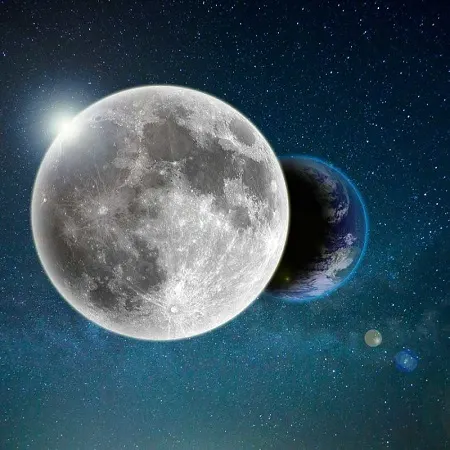
The Moon’s Constant Shape Change

The Moon’s continuous shape change is explained by the varying visibility of its illuminated portion depending on its position relative to the Sun and Earth. This is not a structural transformation but a shift in how the reflected light reaches Earth. Since the lunar phases repeat in a regular cycle, they play an important role not only in astronomy but also in timekeeping. Every visible change is the natural outcome of the Moon’s orbital motion and the reflection of sunlight. Therefore, the scientific explanation for why the Moon constantly changes shape is quite clear. The Moon remains the same during all phases; what changes is simply the angle from which we observe it. This persistent cycle provides valuable insight into the order of the sky and once again confirms the stability of universal physical laws. /

Similar Astronomy Questions and Answers ↓

Why does the Sun appear red at sunset?

Why does the Sun appear red at sunset?

The Sun appears red at sunset because atmospheric scattering removes blue light, allowing red wavelengths to dominate.

Read More
Causes of Space Pollution?

Causes of Space Pollution?

Space pollution causes are briefly explained. The debris accumulated in orbit poses serious danger to Earth.

Read More
Why do planets rotate?

Why do planets rotate?

Planets rotate because of the conservation of angular momentum during the formation of the Solar System.

Read More
Why Do We Always See the Same Side of the Moon?

Why Do We Always See the Same Side of the Moon?

From Earth, we always see the same side of the Moon because its rotation period and orbital period are equal.

Read More
Why there are not few stars but many stars in the sky?

Why there are not few stars but many stars in the sky?

Why there are not few but many stars in the sky is explained by stellar density and cosmic light distribution

Read More
Why do solar and lunar eclipses occur?

Why do solar and lunar eclipses occur?

Solar and lunar eclipses occur when the Earth, Moon, and Sun align in specific positions, causing shadow events.

Read More