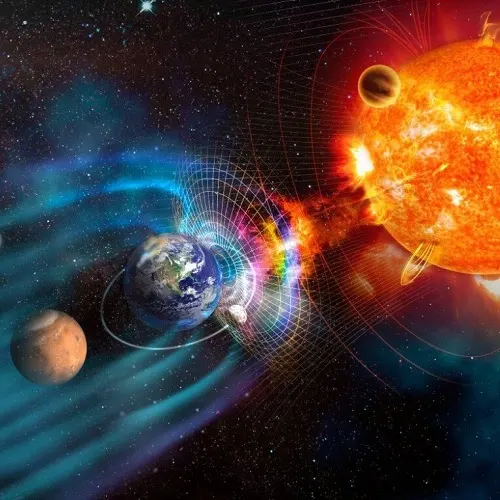
The universe expands due to the dynamic nature of space and the repulsive effect of dark energy.
The question “Why is the universe expanding?” is one of the most fundamental inquiries of modern science and philosophy. The expansion of the universe is not merely the movement of galaxies away from one another, but rather the stretching of space itself. In 1929, American astronomer Edwin Hubble observed that light from distant galaxies was redshifted, revealing that the universe is not static but constantly expanding. This observation provided the first concrete answer to the question Why is the universe expanding. Expansion occurs everywhere at once, much like dots drawn on the surface of a balloon moving apart as it inflates. What moves is not the dots but the surface itself. In the same way, as space expands, the distance between galaxies increases. The fundamental reason for the universe’s expansion lies in the dynamic nature of the fabric of spacetime.
Why the universe expands
The expansion of the universe began about 13.8 billion years ago with the event known as the Big Bang. This was not an explosion in space but the expansion of space itself. Initially, the universe was an extremely dense and hot field of energy. Over time, it cooled, matter condensed, and galaxies, stars, and planets formed. The remarkable fact is that this expansion has not only continued but has been accelerating. In the 1990s, observations of distant supernovae showed that galaxies are receding faster than expected. This revealed the presence of a mysterious force driving the acceleration: dark energy. This energy permeates all of space and acts as a repulsive force, increasing the rate of cosmic expansion. Thus, the source of the universe’s expansion lies not only in the Big Bang but also in the persistent effect of dark energy.
The nature of cosmic expansion
The universe’s expansion is not the motion of matter through space but the growth of space itself. This distinction is crucial to understanding cosmology. Even light is affected by this expansion; as it travels through space, its wavelength stretches and shifts toward the red. This “cosmological redshift” is direct evidence that the universe is expanding. Because the expansion occurs on a cosmic scale, every galaxy appears to be receding from us, regardless of direction. This uniform expansion implies that the universe has no true center—every point can be considered the center from its own perspective.
The future and consequences of expansion
Scientists are still studying how this expansion will evolve. Current observations indicate that dark energy’s influence is increasing, causing the universe to expand ever more rapidly. If this continues indefinitely, stars will drift so far apart that intergalactic contact will cease completely—a scenario called the “Big Freeze.” If, however, dark energy weakens over time, gravity may once again dominate, pulling the universe back together in a “Big Crunch.” Another possibility is that the universe will expand forever, gradually losing its energy and becoming a cold, dark void. In any case, the question Why is the universe expanding holds not only scientific but existential meaning. The expansion connects directly to the flow of time, the fate of matter, and the ultimate future of life.
Understanding why the universe expands
To understand why the universe expands is to grasp its very nature. Expansion is a fundamental property of spacetime itself, not something caused by an external force. Dark energy sustains this process, continuously pushing space outward. This proves that the universe is not static but in constant motion and transformation. As the universe expands, time progresses, matter becomes more diffuse, and energy distribution changes. Perhaps this endless expansion is the clearest manifestation of the continuity of existence. /